
Include a partner or children by planning the maternity session in layers: begin with core maternity portraits, add partner images, then create a small number of family or sibling combinations. Coordinated outfits and a clear shot plan keep the bump and pregnancy story at the centre rather than turning the session into a generic family shoot.
Keep the maternity story at the centre
The most common way a maternity session goes sideways is that it quietly becomes a family shoot. Everyone arrives at once, the children take up the energy in the room, and by the time there’s space for solo portraits the light has been reset four times and the mum-to-be has spent the session managing everyone else.
The fix is structural rather than emotional. Shoot in layers: you alone first, then you with your partner, then the family combinations, then a final few solo frames at the end. That order protects the images you booked the session for and treats everything else as an addition rather than a competitor.
It also changes what the family frames look like. When the bump has already been photographed properly, the group images can be about connection — hands, closeness, a shared look — instead of trying to do two jobs at once.
Best partner poses for maternity portraits
A small number of set-ups covers almost every couple, and they all rest on the same principle: give the partner something to do with their hands, and the awkwardness disappears.
- Behind and around. Partner stands behind, arms wrapped under the bump, chin resting near your shoulder. The most reliable frame there is.
- Facing, foreheads together. Quiet, intimate, and it hides self-consciousness because neither of you is looking at the camera.
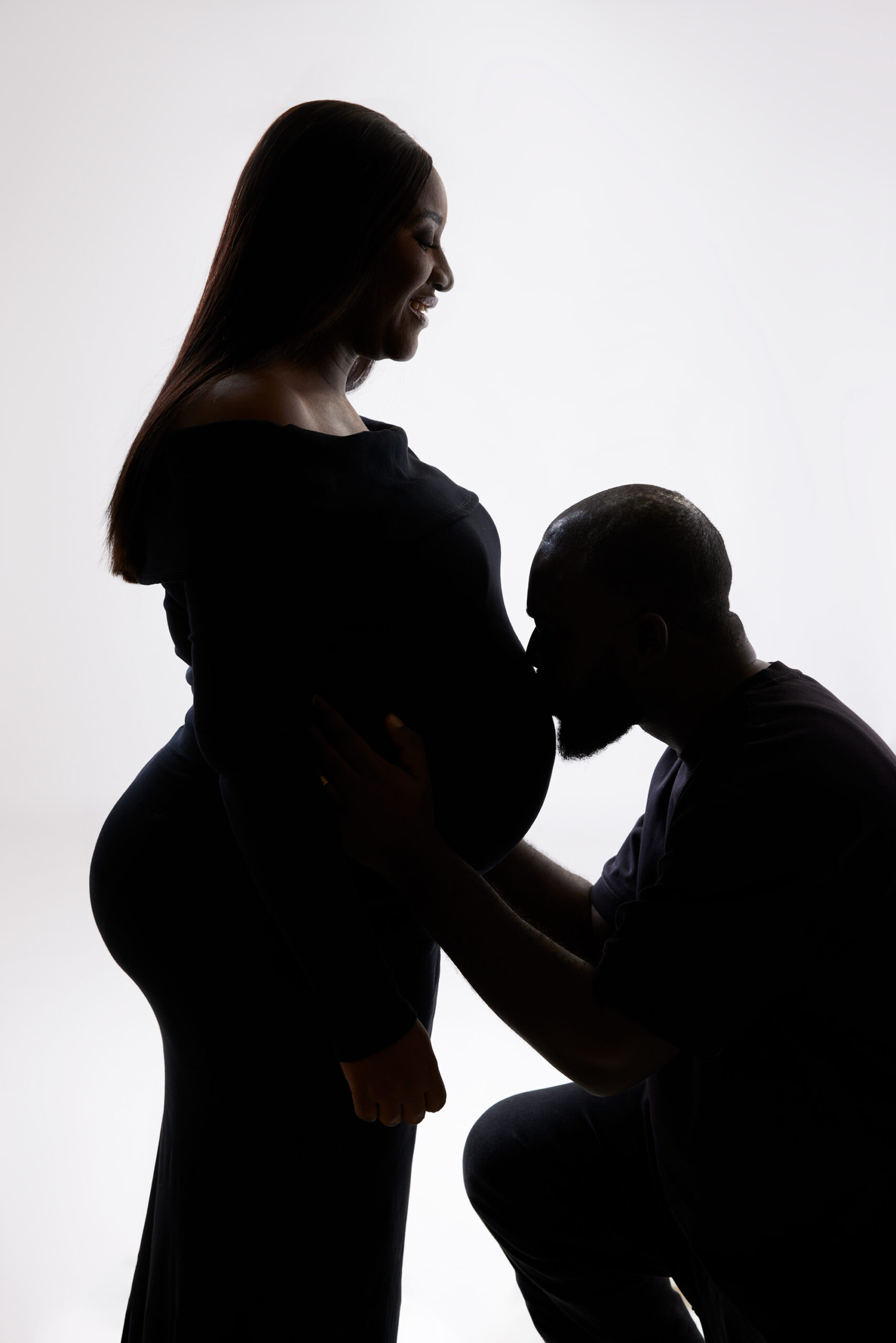
- Profile silhouette. Both in profile with hands meeting on the bump — graphic, timeless and very easy to hold.
- Seated on the floor. Partner behind, you leaning back into them. Comfortable in late pregnancy and naturally relaxed.
- Kneeling or leaning to the bump. Partner listening or kissing the belly. Emotionally direct without needing any acting.
Height differences are worth planning for rather than fighting. If there’s a significant gap, seated and floor set-ups solve it instantly and look more natural than asking someone to crouch.
How to include older children
Children from roughly four upwards can follow direction, and the trick is to give them a role rather than a pose. “Put your hand here and tell the baby a secret” produces something real; “stand there and smile” produces the expression every parent recognises and nobody wants framed.
Older children often respond well to being told what the picture is for — that these are photographs of the family before their brother or sister arrives. It gives the session meaning for them and turns a chore into a part they’re playing.
Build in a few frames of them on their own too. It costs two minutes, it keeps them invested, and it gives you portraits of them at this exact age, which becomes valuable later in a way that’s hard to appreciate on the day.
How to include a toddler without forcing it
Toddlers don’t pose, and any plan that depends on them doing so will fail. What works instead is creating a situation and photographing whatever happens inside it: sitting on your lap, being lifted by a partner, kissing the bump if they want to, running between the two of you if they don’t.
Timing matters more than technique. Schedule around naps, bring the snack they actually like, and accept that you have roughly ten to fifteen usable minutes. We aim to get the family frames done well inside that window rather than trying to extend it.
If a toddler won’t engage with the bump at all, don’t push it. A photograph of a two-year-old being carried while you stand alongside tells the same story, and it doesn’t come with a distressed child in the frame.
What partners and children should wear
Coordinate rather than match. Pick your look first, then build a three-colour palette around it — for example cream, oatmeal and soft denim — and dress everyone from those three. The group holds together without looking like a uniform.
For partners, a plain t-shirt, fitted knit or open shirt in a neutral tone with dark jeans or chinos covers almost every session. Match the level of formality to yours: a gown needs a shirt, a jeans-and-shirt look for you doesn’t.
For children, comfort beats everything. Soft, familiar clothes in palette colours, no large logos or printed characters, and a full spare set in the bag. A child who’s itchy or too warm will end the family portion of the session before you’ve got what you came for.
Planning family combinations efficiently
Write the list before the day. It takes five minutes and it’s the difference between finishing with everything you wanted and remembering in the car that nobody photographed you with your eldest alone.
| Order | Combination | Why here |
|---|---|---|
| 1 | You, solo | Your energy and the light are both freshest |
| 2 | You and partner | Warms both of you up before children arrive |
| 3 | Whole family | Get the hardest group frame while attention lasts |
| 4 | You and each child | Quick, meaningful, easy to hold |
| 5 | Partner and children | Gives you a break and them something to do |
| 6 | You, solo again | Final looks, now fully relaxed |
Six combinations is plenty. Beyond that you’re spending the session arranging people rather than photographing them, and the returns drop sharply.
Meaningful touch and connection prompts
Prompts work where poses don’t. Instead of arranging limbs, we ask for an action and photograph the response — which is why family images from a guided session look unstaged even though they were entirely planned.
- “Both put a hand on the bump and find where the baby’s kicking.”
- “Tell the baby what you’re most looking forward to.”
- “Whisper something to each other you wouldn’t say out loud.”
- “Walk towards me together, slowly, and don’t look at the camera.”
- To a child: “Give the bump the biggest cuddle you can.”
“We don’t ask families to hold a pose. We ask them to do something, then photograph the second or two afterwards — that’s where the real expression lives.”
When solo maternity portraits should happen
At the start, and again at the end. The opening block is when you’re freshest and the room is calmest, and it guarantees the core images exist before any variable — a tired toddler, an overrunning outfit change — has a chance to interfere.
The closing block is often where the best frames come from. By then you’ve seen images on the back of the camera, you know what the process feels like, and the self-consciousness has gone. If your session includes a bolder or more minimal look, that’s where we place it.
If children are joining, arrange for someone to take them out or occupy them elsewhere for that final block. Twenty uninterrupted minutes at the end is worth more than an hour of half-attention.
What to do if a child loses interest
Assume it will happen, because it usually does, and treat it as a scheduled event rather than a problem. The moment attention goes, we stop asking and move on — arguing with a three-year-old in front of a camera has never once produced a good photograph.
The practical sequence is: pause, snack, let them wander, and continue with a combination that doesn’t need them. Very often they rejoin voluntarily ten minutes later, and those frames are better than the ones we were pushing for.
Bringing a grandparent, friend or second adult is the single most effective thing you can do here. Someone whose only job is the children means you’re not switching between being photographed and being a parent every ninety seconds.
AOU Studio family-inclusive approach
We bring partners and children in partway through rather than at the start, so they’re fresh and relaxed at the point they’re needed instead of restless from waiting. Everything is lit and set up before anyone walks in, which means the family portion doesn’t lose time to equipment.
Our approach with families is a few guided frames followed by room for the real moments in between — a toddler climbing up, a partner laughing at something, the small unplanned things that end up being the images you keep. We keep it playful and natural rather than formal.
Before the day we’ll ask who’s joining and roughly how old the children are, and we’ll build the running order around that rather than around a standard template. A session with a nine-year-old and a session with an eighteen-month-old are not the same session.
Common mistakes to avoid
- Mistake: Bringing everyone in at the start. Better: Shoot solo maternity portraits first and add people in layers.
- Mistake: Booking during nap time because it suited the diary. Better: Schedule around your child’s rhythm, even if it’s less convenient for you.
- Mistake: Dressing the family in identical outfits. Better: Use a three-colour palette so everyone coordinates without matching.
- Mistake: Insisting on a frame a toddler is clearly refusing. Better: Move on, come back in ten minutes, and take what’s freely given.
- Mistake: Leaving with no photographs of you and each child individually. Better: Write the combination list before the day and work through it.
Practical checklist
- Write your list of family combinations and share it before the day.
- Agree a three-colour palette and check every outfit against it.
- Book the session around naps and mealtimes, not around your calendar.
- Bring a second adult whose only job is the children.
- Pack spare clothes, familiar snacks and one small distraction.
- Protect a final solo block at the end with the children occupied elsewhere.
Nottingham-specific notes
Our studio is a private indoor space, which makes it far more forgiving for families than a public location. A toddler who needs ten minutes off can sit in the corner with a snack while we carry on, and nothing about the session depends on the weather holding.
For families travelling in from Beeston, West Bridgford, Hucknall or further across the East Midlands, mid-morning tends to be the sweet spot — after the school run, before lunch and naps, and outside the worst of the traffic. If you’re coordinating grandparents to help with the children, that window usually suits them too.
How AOU Studio approaches this
The most common regret we hear is not about a missing family portrait. It’s that there weren’t enough photographs of the mum-to-be on her own. When the whole family attends, the natural instinct is to be generous with the time and give it to everyone else, and it’s only when the gallery arrives that the imbalance becomes obvious.
That’s why we structure sessions the way we do rather than leaving the order to chance. Solo first, solo again at the end, family in the middle. Nobody has ever objected to that once it’s explained, and it consistently produces galleries people are happier with.
The second thing worth saying plainly: partners are almost always more nervous than they let on, and children behave in whatever way they were going to behave regardless of planning. Neither is a problem. A partner needs about ten minutes and one instruction that gives them something to do. A child needs low expectations and a snack. Advice that promises perfectly behaved family portraits is selling something that doesn’t exist — and the slightly chaotic frames tend to be the ones families love most anyway.
Frequently asked questions
Can my partner join my maternity photoshoot?
Yes, and it’s very common. We usually bring partners in partway through, once your solo portraits are done, so the maternity images stay the focus of the session.
Can siblings join?
Absolutely. Older children are photographed alongside you and individually, and toddlers are worked with rather than posed — we plan for a short, well-timed window rather than expecting sustained cooperation.
Should everyone wear the same colour?
No — coordinate rather than match. A three-colour palette shared across the family looks considered, while identical outfits tend to read as a uniform.
Can I still have plenty of solo photos?
Yes, and we build the session to guarantee it. Solo portraits are shot at the start and again at the end, with family combinations placed in between.