

For most maternity portraits, the most comfortable and visually popular window is often late in the second trimester through the earlier part of the third trimester. The exact timing depends on how your pregnancy feels, how prominently you want the bump to show, and whether you are expecting one baby or multiples. Treat this as photography planning guidance, not medical advice.
The short answer: choosing your maternity photography window
There is no single correct week, and anyone who tells you otherwise is describing a preference rather than a rule. What most clients are balancing is two things moving in opposite directions: the bump becomes more defined as pregnancy progresses, while comfort, energy and ease of movement generally decline.
The window people tend to settle on is the point where those two lines cross for them personally — a bump that reads clearly in profile, with enough stamina left to stand, turn and change outfits across a couple of hours. For many that falls somewhere in the last stretch of the second trimester or the first part of the third, but the useful version of that answer is the one shaped around your own pregnancy.
If you want one practical instruction to act on: decide the window with your own comfort in mind, then book the date well before you reach it.
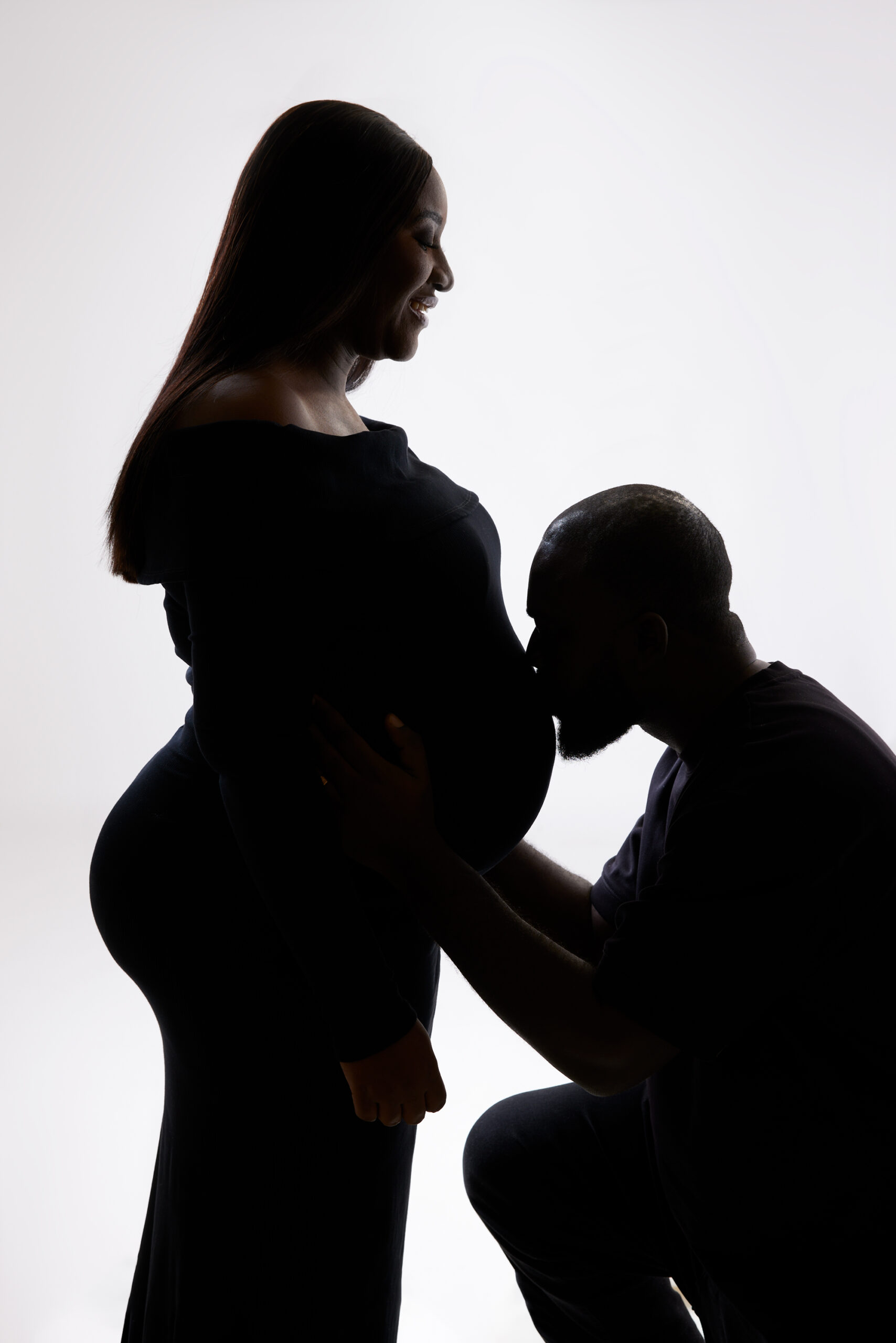
Why bump size and comfort both matter
Bump size is the factor everyone considers first, and it does matter — a bump needs enough definition to read as the subject of the photograph rather than as a soft curve under fabric. Below a certain point, clothing has to work hard to show what’s there, and the images become about styling instead of pregnancy.
Comfort is the factor people underweight, and it shows up directly in the pictures. Standing under lights, holding a posture, turning repeatedly and changing between three outfits is more physical than it sounds. When someone is tired, swollen or uncomfortable, it registers in the shoulders and the jaw long before anyone says anything, and no amount of retouching fixes it.
Bumps also vary enormously between pregnancies at the same stage — height, torso length, muscle tone, whether it’s a first baby and position all affect how a bump presents. That’s why comparing yourself to someone else’s timeline is rarely useful. The better question is how you feel at a given week, not what number that week is.
When earlier maternity photography can make sense
Shooting earlier than average is a legitimate choice, not a compromise, and there are several situations where it’s clearly the better call.
- You’re showing early. Some bumps are clearly defined well before the third trimester, which simply widens your options.
- You want an outdoor session. Walking, uneven ground and standing in a park are all easier earlier, and it leaves room for a weather-related reschedule.
- You have young children joining. Lifting a toddler or getting up from the floor gets harder as pregnancy progresses.
- You want several outfit changes. More looks means more time on your feet, which is easier when energy is higher.
- Your healthcare team has advised it, or your circumstances make later timing less predictable.
The trade-off is straightforward: an earlier bump is smaller. Fitted clothing, profile poses and directional lighting all help define it, and in practice this is much less of a limitation than people assume.
When a later session may still work
A later session can produce beautiful, dramatic images — the bump at its most defined, and an unmistakable sense of a moment right before everything changes. If you feel well and your healthcare team has no concerns, there’s no reason to rule it out.
What changes is how the session needs to be built. Later shoots work best with fewer outfit changes, more seated and floor-based set-ups, more frequent breaks and a shorter overall run time. We’d rather plan a well-paced ninety minutes than an ambitious three hours nobody enjoys.
The genuine risk is scheduling. The closer a session sits to a due date, the smaller the margin if you need to move it, and the harder it is to find an alternative date that still falls inside the window. If you’re choosing a late session, build in a fallback rather than assuming one will be available.
“The best week for your photographs is the one where you still feel like moving. Everything else — light, styling, posing — is ours to solve.”
How multiples or changing circumstances affect planning
Twins and other multiple pregnancies follow a different timeline, and the practical effect on photography is that both the bump and the fatigue tend to arrive earlier. Most clients expecting multiples end up booking noticeably sooner than they first planned, and are glad they did.
The same principle applies to any pregnancy where circumstances might change — a condition being monitored, advice about rest or activity, a history that makes later timing less certain. In all of these cases, your healthcare team’s guidance comes first and the photographs are arranged around it. We’d always rather move a session earlier than have you weighing a shoot against medical advice.
Practically, that means telling us if your situation is uncertain. It changes what we recommend, how much flexibility we build into the date, and how the session itself is paced.
How far ahead to reserve a Nottingham studio date
This is where most planning goes wrong. People decide roughly when they want to shoot, then contact a photographer at around that point — by which time the specific weekend they need has gone. Reserving the date and choosing the week are two separate decisions, and the reservation should happen much earlier.
| Situation | Reserve as early as | Why |
|---|---|---|
| Weekday studio session, flexible on date | A few weeks ahead | Weekdays hold availability longest |
| Saturday or Sunday session | Well in advance | Weekend dates are the first to go, year-round |
| Partner needs to book time off | As soon as the window is decided | Annual leave is usually the longest lead time involved |
| Specific gown from the wardrobe | At the point of booking | Popular pieces get reserved for other sessions |
| Outdoor session | Earlier than you’d think | You need a backup date held as well as the first choice |
| Expecting multiples | Immediately | Your window is both earlier and narrower |
Booking early doesn’t lock you into a bad decision. It’s far easier to adjust a held date than to find a new one from scratch at short notice.
What to do if your preferred week is already booked
First, widen before you panic. A week either side is rarely a meaningful difference photographically, and clients who move by seven days almost never notice it in the finished gallery.
Second, consider a weekday. Availability is consistently better, the studio is quieter, and if you’re able to take a morning off it’s usually the fastest route to the week you wanted.
Third, ask about cancellations. Maternity schedules move for all sorts of reasons, and dates do free up. If you’re willing to be contacted at short notice, say so when you enquire.
What we’d steer you away from is pushing the session much later to hold onto a particular date. Trading comfort for a diary preference is the wrong way round — the date is a logistics problem, and comfort is what actually shows up in the photographs.

AOU Studio planning approach in Nottingham
When you enquire, we’ll ask your due date, whether you’re expecting one baby or more, and whether you’re leaning towards studio or outdoor. Those three answers are usually enough to suggest a sensible window rather than a single week.
From there we hold a date and keep the details open. Outfits, gown reservations, who’s joining and the running order are all confirmed closer to the time, once you know how the pregnancy is progressing. There’s no need to have every decision made in order to secure a slot.
If your circumstances change — comfort, advice from your midwife or consultant, anything at all — tell us and we’ll move things. That flexibility is deliberate, and it’s easier to offer when a date was booked with room to spare.
Common mistakes to avoid
- Mistake: Waiting until the bump feels “big enough” before contacting anyone. Better: Reserve the date early and refine the week later — availability, not biology, is the binding constraint.
- Mistake: Copying a week you saw recommended online. Better: Choose around your own comfort and how your bump is presenting.
- Mistake: Booking a late session with no fallback date. Better: The closer to your due date, the more important a backup becomes.
- Mistake: Planning an outdoor session for late pregnancy in winter. Better: Shoot outdoors earlier in the pregnancy or move indoors — weather and walking both work against you.
- Mistake: Treating a photographer’s suggested week as medical guidance. Better: Your healthcare team’s advice comes first; the shoot fits around it.
Practical checklist
- Note your due date and whether you’re expecting one baby or multiples.
- Decide studio or outdoor — it changes how early you should shoot.
- Check whether a partner needs to book time off, and start there.
- Reserve a date well before the week you’re aiming for, weekends especially.
- Agree a fallback date if you’re shooting late or outdoors.
- Raise anything your midwife or consultant has said that affects timing.
Nottingham-specific notes
Season affects timing here more than most people expect, and only in one direction: outdoor sessions. Spring and autumn are the strongest outdoor months in Nottingham, while short winter daylight makes an outdoor shoot between November and February impractical for most pregnancies. If your window falls in that stretch, a studio session removes the problem entirely.
Studio dates are weatherproof but not limitless. Weekend slots go first throughout the year, and demand rises noticeably in the run-up to spring and again in early autumn. If you’re travelling in from Beeston, West Bridgford, Hucknall or across the wider East Midlands and need a Saturday, that’s the combination worth booking earliest.
How AOU Studio approaches this
The single most common thing we hear is a version of “I think I’ve left it too late.” Sometimes that’s about the bump, but far more often it’s about the calendar — someone has decided on a good window and then found the dates inside it already taken. Almost none of these enquiries are actually too late; they’ve simply lost the flexibility they would have had a month earlier.
The second pattern is that people consistently underestimate how much comfort drops in the final weeks, and consistently overestimate how much bump size matters to the finished image. Clients who shot earlier than they originally planned rarely mention the size of their bump afterwards. Clients who shot very late often mention how tired they were.
Where generic advice fails here is in publishing a specific week as though it applied universally. It can’t — bodies, pregnancies, energy levels and circumstances vary far too much, and a number lifted from a blog post carries an authority it hasn’t earned. This is photography planning, and it should sit behind your own comfort and anything your healthcare team has advised.
Frequently asked questions
What week is best for maternity photos?
There is no single medically “correct” week for photographs. Most clients choose a stage when the bump is clearly visible but they still feel comfortable enough to pose and move.
Should I wait until my bump is very large?
Not necessarily. A well-shaped bump photographs beautifully before the final weeks, and earlier timing can offer more comfort and flexibility.
When should I actually make the booking?
Reserve your date earlier than the week you want to shoot, especially if you need a weekend, a specific gown or coordinated schedules with a partner.
Is maternity photoshoot timing medical advice?
No. Photography timing should always sit behind your own comfort and any advice from your healthcare team.